0%

回溯算法


理解回溯

什么是回溯?

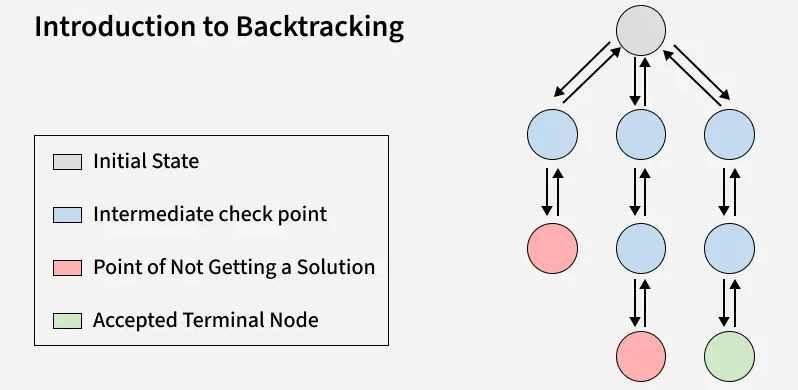
回溯是一类用于寻找计算问题解的算法,特别适用于约束满足和枚举问题。它的工作方式是:

  1. 逐步构建候选解
  2. 一旦确定某个候选解不可能完成为有效解,就放弃它(”回溯”)

“回溯就像探索迷宫——你尝试一条路,如果走不通,就返回上一个决策点,尝试另一条。”

pic

现实世界类比

场景 回溯等价操作
解迷宫 尝试路径 → 遇到死胡同 → 返回岔路口 → 尝试下一条路径
数独求解器 放置数字 → 检查冲突 → 回溯 → 尝试下一个数字
自动纠错 生成单词 → 查字典 → 回溯 → 尝试不同字母

何时使用回溯

适合的问题:

  • 生成所有有效的组合/子集/排列
  • 约束满足问题(N 皇后、数独)
  • 具有明确”有效/无效”判定的决策树
  • 需要枚举所有解的问题

不适合:

  • 寻找单一最优路径(使用 Dijkstra/BFS)
  • 无序线性搜索
  • 没有”部分候选解”概念的问题

核心模式

三步循环

1
Choose → Explore → Undo
步骤 代码模式 目的
选择 path.add(candidate) 做出决策
探索 dfs(next_level) 深入
撤销 path.remove(path.size() - 1) 恢复状态

为什么”撤销”至关重要

没有撤销步骤:

有撤销 没有撤销
✅ 每个分支结束后状态恢复 ❌ 后续分支继承了错误的状态
✅ 每个分支独立探索 ❌ 分支之间产生”污染”
✅ 正确遍历解空间 ❌ 遗漏有效解

标准模板

1
2
3
4
5
6
7
8
9
10
11
12
13
14
15
16
17
18
19
void backtrack(int startIndex, List<Integer> path, List<List<Integer>> res) {
// 1. Base case: when to stop?
if (终止条件) {
res.add(new ArrayList<>(path));
return;
}

// 2. Loop through choices
for (int i = startIndex; i < n; i++) {
// 3. Choose
path.add(nums[i]);

// 4. Explore
backtrack(i + 1, path, res);

// 5. Undo (backtrack)
path.remove(path.size() - 1);
}
}

决策树心智模型

树的层级与分支

1
2
3
4
5
6
7
8
                Level 0 (root)
/ | \
/ | \
/ | \
Level 1:1 Level 1:2 Level 1:3 ← Different branches at same level
/ \ / \
/ \ / \
Level 2:2 Level 2:3 Level 2:3 ← Deeper level
  • 层级(Level):树中的深度(已做出多少个选择)
  • 分支(Branch):同一层级的不同选项(替代方案)

理解 startIndex

startIndex 控制当前层级从哪里开始搜索。

场景 startIndex 行为
组合 i + 1 - 从下一个元素开始
排列 始终为 0 - 可以使用任何未使用的元素
子集 i + 1 - 扩展搜索范围

i + 1 的真正含义

1
2
3
4
If we pick element at index i:
- Current level: uses nums[i]
- Next level: starts from index i + 1
- Result: avoids reusing nums[i] or earlier elements

为什么这能防止重复:

  • Branch 1 (start=0): picks nums[0]=1 → then search range [1,2,3…]
  • Branch 2 (start=1): picks nums[1]=2 → then search range [2,3…]
  • Branch 3 (start=2): picks nums[2]=3 → then search range [3…]
  • Result: [1,2] and [2,1] never both appear

剪枝:必要性,而非优化

提前终止逻辑

剪枝消除不可能成功的路径:

1
2
3
4
5
Example: Choose k elements from n
Remaining elements needed: k - path.size()
Remaining elements available: n - i + 1

If (n - i + 1 < k - path.size()) → impossible to succeed → skip

约束条件:i <= n - (k - path.size()) + 1

变量 含义
n 可用元素总数
k 目标元素数量
path.size() 已选择的元素数量
n - i + 1 剩余元素数量(包含当前元素)

剪枝实践

1
2
3
4
5
6
7
8
9
10
11
12
13
// Without pruning - explores unnecessary branches
for (int i = startIndex; i <= n; i++) {
path.add(nums[i]);
backtrack(i + 1, path, res);
path.remove(path.size() - 1);
}

// With pruning - skips impossible branches
for (int i = startIndex; i <= n - (k - path.size()) + 1; i++) {
path.add(nums[i]);
backtrack(i + 1, path, res);
path.remove(path.size() - 1);
}

去重策略

为什么去重很重要

没有去重时,包含重复值的问题会产生重复的结果:

输入 不去重 去重后
[1,1,2] [[1,1,2],[1,2,1],[1,1,2],[1,2,1],…] [[1,1,2],[1,2,1]]

i > startIndex 模式

1
if (i > startIndex && nums[i] == nums[i - 1]) continue;

正确理解:

  • i > startIndex:我们在同一树层(同一决策深度)
  • nums[i] == nums[i-1]:与前一个分支相同的值
  • 含义:避免在同一层级内两次选择相同的值

它不意味着:

  • ❌ “输入中不允许有重复值”
  • ❌ “结果中不允许有重复值”

从易到难:题目递进

组合

问题:从 n 个元素中选择 k 个,顺序无关

关键约束: startIndex + i + 1

模板:

1
2
3
4
5
6
7
8
9
void combine(int n, int k) {
backtrack(1, n, k, new ArrayList<>(), result);
}

for (int i = startIndex; i <= n - (k - path.size()) + 1; i++) {
path.add(i);
backtrack(i + 1, n, k, path, res);
path.remove(path.size() - 1);
}

子集

问题:生成所有可能的子集(幂集)

关键区别:在每一步都收集结果,而不仅在叶节点

1
2
3
4
5
6
7
8
9
10
void subsets(int[] nums) {
backtrack(0, nums, new ArrayList<>(), res);
res.add(new ArrayList<>()); // empty set
}

// Collect at beginning of each call
res.add(new ArrayList<>(path));
for (int i = startIndex; i < nums.length; i++) {
// ... choose, explore, undo
}

排列

问题:将所有元素按所有可能的顺序排列

关键区别:startIndex 始终为 0,但需要跟踪已使用的元素

1
2
3
4
5
6
7
8
9
10
11
12
13
void permute(int[] nums) {
boolean[] used = new boolean[nums.length];
backtrack(nums, used, new ArrayList<>(), res);
}

for (int i = 0; i < nums.length; i++) {
if (used[i]) continue; // Skip already used
used[i] = true;
path.add(nums[i]);
backtrack(nums, used, path, res); // startIndex remains 0
path.remove(path.size() - 1);
used[i] = false;
}

N 皇后

问题:在 N×N 棋盘上放置 N 个皇后,使得任意两个皇后不互相攻击

约束:

  • 每行一个皇后
  • 每列一个皇后
  • 同一对角线上不能有两个皇后

状态跟踪:

1
2
3
4
5
6
7
8
9
10
11
12
13
// Columns occupied
boolean[] cols = new boolean[n];

// Diagonal \ (row - col is constant)
boolean[] diag1 = new boolean[2 * n - 1];

// Diagonal / (row + col is constant)
boolean[] diag2 = new boolean[2 * n - 1];

// Check before placing queen at (row, col)
if (!cols[col] && !diag1[row - col + n - 1] && !diag2[row + col]) {
// Place queen and recurse
}

“低效”的错觉

为什么感觉什么都没做

1
2
3
4
5
6
7
Most paths are invalid
↓
Constant loop of: Try → Fail → Backtrack → Try again
↓
No immediate visible progress
↓
Feeling of "wasting time"

现实:回溯是在排除错误答案,而非直接构建正确答案。

拥抱过程

心态 影响
“这没用” 容易放弃
“我在缩小搜索空间” 持久、系统化
“每次失败都告诉我什么行不通” 学习方法

现实世界应用

任务调度

1
2
3
4
5
6
Constraints:
- Task A must finish before B
- Task C requires 2GB RAM
- Only 3 tasks can run in parallel

Backtracking finds all valid schedules

配置生成

1
2
3
4
Generate all valid configurations:
- Option 1: [A, B, C]
- Option 2: [A, B, D]
- Option 3: [A, C, D] ← skips invalid [A, B, E] due to constraints

约束求解

领域 回溯应用
AI 规划 实现目标的动作序列
电路设计 带约束的元件放置
资源分配 在限制条件下分配资源
游戏 AI 搜索所有可能的走法和应对走法

可复用的心智模型

六个关键问题

在编写回溯代码之前,先问:

  1. 结果是什么?(res - List<List<>> 或类似结构)
  2. 当前路径是什么?(path - 我们正在构建的)
  3. 每一步有哪些选择?(for 循环的候选项)
  4. 何时应该停止?(基本情况 / 终止条件)
  5. 需要去重吗?(输入中有重复值)
  6. 能剪枝吗?(提前终止条件)

决策树检查清单

1
2
3
4
5
6
7
8
9
10
11
12
13
14
15
16
17
18
19
[ ] Define the tree structure
- What represents a level?
- What represents branches at each level?

[ ] Identify the state to track
- Current path
- Used elements / visited nodes
- Constraints satisfaction

[ ] Write the base case first
- When is a complete solution found?
- When should we abandon early?

[ ] Implement the loop
- What is the search range?
- How do we avoid duplicates?

[ ] Verify undo works correctly
- Does state restore after each iteration?

常见 LeetCode 题目

题目 难度 核心概念 结果数量
[78] 子集 中等 每一步都收集 2^n
[77] 组合 中等 startIndex + 剪枝 C(n,k)
[46] 全排列 中等 跟踪已使用元素 n!
[784] 字母大小写全排列 中等 条件分支 2^L (L=字母数)
[22] 括号生成 中等 有效性检查 Catalan(n)
[39] 组合总和 中等 允许重复使用 不定
[40] 组合总和 II 中等 去重 不定
[51] N 皇后 困难 二维约束跟踪 不定
[131] 分割回文串 中等 有效性检查 不定
[93] 复原 IP 地址 中等 多重约束 不定

1. [78] 子集 - 中等

问题:给定一个不含重复元素的整数数组 nums,返回所有可能的子集。

1
2
3
4
5
6
7
8
9
10
11
12
13
14
15
16
17
class Solution {
public List<List<Integer>> subsets(int[] nums) {
List<List<Integer>> res = new ArrayList<>();
backtrack(nums, 0, new ArrayList<>(), res);
return res;
}

private void backtrack(int[] nums, int startIndex,
List<Integer> path, List<List<Integer>> res) {
res.add(new ArrayList<>(path));
for (int i = startIndex; i < nums.length; i++) {
path.add(nums[i]);
backtrack(nums, i + 1, path, res);
path.remove(path.size() - 1);
}
}
}

树的遍历,nums = [1,2,3](8 个结果 = 2^3):

1
2
3
4
5
6
7
8
9
[]
├── 1
│ ├── 2
│ │ └── 3 → [1,2,3]
│ └── 3 → [1,3]
└── 2
└── 3 → [2,3]
→ [] [1] [1,2] [1,2,3] [1,3] [2] [2,3] [3]
Total: 8 subsets

2. [77] 组合 - 中等

问题:返回从 [1, n] 中选择 k 个数的所有可能组合。

1
2
3
4
5
6
7
8
9
10
11
12
13
14
15
16
17
18
19
20
class Solution {
public List<List<Integer>> combine(int n, int k) {
List<List<Integer>> res = new ArrayList<>();
backtrack(1, n, k, new ArrayList<>(), res);
return res;
}

private void backtrack(int startIndex, int n, int k,
List<Integer> path, List<List<Integer>> res) {
if (path.size() == k) {
res.add(new ArrayList<>(path));
return;
}
for (int i = startIndex; i <= n - (k - path.size()) + 1; i++) {
path.add(i);
backtrack(i + 1, n, k, path, res);
path.remove(path.size() - 1);
}
}
}

树的遍历,n=4, k=2(6 个结果 = C(4,2)):

1
2
3
4
5
6
7
8
9
10
11
12
[]
├── 1
│ ├── 2 → [1,2]
│ ├── 3 → [1,3]
│ └── 4 → [1,4]
├── 2
│ ├── 3 → [2,3]
│ └── 4 → [2,4]
├── 3
│ └── 4 → [3,4]
└── 4 (pruned - not enough remaining)
Total: 6 combinations

3. [46] 全排列 - 中等

问题:返回所有可能的不同整数的排列。

1
2
3
4
5
6
7
8
9
10
11
12
13
14
15
16
17
18
19
20
21
22
23
24
class Solution {
public List<List<Integer>> permute(int[] nums) {
List<List<Integer>> res = new ArrayList<>();
boolean[] used = new boolean[nums.length];
backtrack(nums, used, new ArrayList<>(), res);
return res;
}

private void backtrack(int[] nums, boolean[] used,
List<Integer> path, List<List<Integer>> res) {
if (path.size() == nums.length) {
res.add(new ArrayList<>(path));
return;
}
for (int i = 0; i < nums.length; i++) {
if (used[i]) continue;
used[i] = true;
path.add(nums[i]);
backtrack(nums, used, path, res);
path.remove(path.size() - 1);
used[i] = false;
}
}
}

树的遍历,nums = [1,2,3](6 个结果 = 3!):

1
2
3
4
5
6
7
8
9
10
11
12
13
14
15
16
17
[]
├── 1
│ ├── 2
│ │ └── 3 → [1,2,3]
│ └── 3
│ └── 2 → [1,3,2]
├── 2
│ ├── 1
│ │ └── 3 → [2,1,3]
│ └── 3
│ └── 1 → [2,3,1]
├── 3
│ ├── 1
│ │ └── 2 → [3,1,2]
│ └── 2
│ └── 1 → [3,2,1]
Total: 6 permutations

4. [784] 字母大小写全排列 - 中等

问题:给定一个字符串,返回所有可能的大小写组合的字符串。

1
2
3
4
5
6
7
8
9
10
11
12
13
14
15
16
17
18
19
20
21
22
23
24
25
26
27
28
class Solution {
public List<String> letterCasePermutation(String s) {
List<String> res = new ArrayList<>();
backtrack(s.toCharArray(), 0, new StringBuilder(), res);
return res;
}

private void backtrack(char[] arr, int index, StringBuilder sb,
List<String> res) {
if (index == arr.length) {
res.add(sb.toString());
return;
}
char c = arr[index];
if (Character.isLetter(c)) {
sb.append(Character.toLowerCase(c));
backtrack(arr, index + 1, sb, res);
sb.deleteCharAt(sb.length() - 1);
sb.append(Character.toUpperCase(c));
backtrack(arr, index + 1, sb, res);
sb.deleteCharAt(sb.length() - 1);
} else {
sb.append(c);
backtrack(arr, index + 1, sb, res);
sb.deleteCharAt(sb.length() - 1);
}
}
}

树的遍历,s = "a1b"(4 个结果 = 2^2):

1
2
3
4
5
6
7
8
9
10
""
├── a
│ └── 1
│ └── b → "a1b"
│ └── B → "a1B"
└── A
└── 1
└── b → "A1b"
└── B → "A1B"
Total: 4 permutations

5. [22] 括号生成 - 中等

问题:生成所有有效括号组合。

1
2
3
4
5
6
7
8
9
10
11
12
13
14
15
16
17
18
19
20
21
22
23
24
class Solution {
public List<String> generateParenthesis(int n) {
List<String> res = new ArrayList<>();
backtrack(n, n, new StringBuilder(), res);
return res;
}

private void backtrack(int left, int right, StringBuilder sb, List<String> res) {
if (left == 0 && right == 0) {
res.add(sb.toString());
return;
}
if (left > 0) {
sb.append('(');
backtrack(left - 1, right, sb, res);
sb.deleteCharAt(sb.length() - 1);
}
if (right > left) {
sb.append(')');
backtrack(left, right - 1, sb, res);
sb.deleteCharAt(sb.length() - 1);
}
}
}

树的遍历,n=3(5 个结果 = Catalan(3)):

1
2
3
4
5
6
7
8
9
10
11
12
13
14
""
├── (
│ ├── (
│ │ ├── (
│ │ │ └── ) → "((()))"
│ │ └── )
│ │ └── ) → "(()())"
│ └── )
│ ├── (
│ │ └── ) → "(())()"
│ └── (
│ └── ) → "()()()"
└── ) (invalid - skipped)
Total: 5 valid combinations

6. [39] 组合总和 - 中等

问题:找出所有唯一组合,使得选中的数字之和等于目标值(允许重复使用)。

1
2
3
4
5
6
7
8
9
10
11
12
13
14
15
16
17
18
19
20
21
class Solution {
public List<List<Integer>> combinationSum(int[] candidates, int target) {
List<List<Integer>> res = new ArrayList<>();
backtrack(candidates, 0, target, new ArrayList<>(), res);
return res;
}

private void backtrack(int[] candidates, int startIndex, int target,
List<Integer> path, List<List<Integer>> res) {
if (target == 0) {
res.add(new ArrayList<>(path));
return;
}
if (target < 0) return;
for (int i = startIndex; i < candidates.length; i++) {
path.add(candidates[i]);
backtrack(candidates, i, target - candidates[i], path, res);
path.remove(path.size() - 1);
}
}
}

树的遍历,candidates = [2,3,6,7], target = 7:

1
2
3
4
5
6
7
8
9
10
11
12
13
[]
├── 2
│ ├── 2
│ │ ├── 2
│ │ │ └── 2 → sum=8 (exceeds, backtrack)
│ │ └── 3 → sum=7 → [2,2,3]
│ └── 3
│ └── 3 → sum=8 (exceeds)
└── 3
└── 3
└── 3 → sum=9 (exceeds)
└── 7 → sum=7 → [7]
Total: 2 results: [2,2,3], [7]

7. [40] 组合总和 II - 中等

问题:每个数字只能使用一次;处理重复值。

1
2
3
4
5
6
7
8
9
10
11
12
13
14
15
16
17
18
19
20
21
22
23
class Solution {
public List<List<Integer>> combinationSum2(int[] candidates, int target) {
Arrays.sort(candidates);
List<List<Integer>> res = new ArrayList<>();
backtrack(candidates, 0, target, new ArrayList<>(), res);
return res;
}

private void backtrack(int[] candidates, int startIndex, int target,
List<Integer> path, List<List<Integer>> res) {
if (target == 0) {
res.add(new ArrayList<>(path));
return;
}
if (target < 0) return;
for (int i = startIndex; i < candidates.length; i++) {
if (i > startIndex && candidates[i] == candidates[i - 1]) continue;
path.add(candidates[i]);
backtrack(candidates, i + 1, target - candidates[i], path, res);
path.remove(path.size() - 1);
}
}
}

树的遍历,candidates = [1,1,2,5,6,7,10], target = 8:

1
2
3
4
5
6
7
8
9
10
11
12
13
14
15
16
17
18
[]
├── 1 (first)
│ ├── 1 (second)
│ │ └── 2
│ │ └── 5 → sum=9 (exceeds)
│ │ └── 5 → sum=8 → [1,1,2,5]
│ ├── 2
│ │ └── 5 → sum=8 → [1,2,5]
│ └── 5
│ └── 6 → sum=12 (exceeds)
├── 1 (second - SKIP, same as first at this level)
├── 2
│ └── 6 → sum=8 → [2,6]
└── 6
└── 7 → sum=15 (exceeds)
└── 7
└── 1 → [7,1]
Total: 4 results: [1,1,6], [1,2,5], [2,6], [7,1]

8. [51] N 皇后 - 困难

问题:在 n×n 棋盘上放置 n 个皇后,使得任意两个皇后不互相攻击。

1
2
3
4
5
6
7
8
9
10
11
12
13
14
15
16
17
18
19
20
21
22
23
24
25
26
27
28
29
30
31
32
33
34
35
class Solution {
public List<List<String>> solveNQueens(int n) {
List<List<String>> res = new ArrayList<>();
char[][] board = new char[n][n];
for (char[] row : board) Arrays.fill('.');
boolean[] cols = new boolean[n];
boolean[] diag1 = new boolean[2 * n - 1];
boolean[] diag2 = new boolean[2 * n - 1];
backtrack(0, n, board, cols, diag1, diag2, res);
return res;
}

private void backtrack(int row, int n, char[][] board,
boolean[] cols, boolean[] diag1, boolean[] diag2,
List<List<String>> res) {
if (row == n) {
List<String> solution = new ArrayList<>();
for (char[] r : board) solution.add(new String(r));
res.add(solution);
return;
}
for (int col = 0; col < n; col++) {
if (cols[col] || diag1[row - col + n - 1] || diag2[row + col]) continue;
board[row][col] = 'Q';
cols[col] = true;
diag1[row - col + n - 1] = true;
diag2[row + col] = true;
backtrack(row + 1, n, board, cols, diag1, diag2, res);
board[row][col] = '.';
cols[col] = false;
diag1[row - col + n - 1] = false;
diag2[row + col] = false;
}
}
}

树的遍历,n=4(2 个结果):

1
2
3
4
5
6
7
8
9
10
11
12
13
14
Row 0
├── Col 0 (Q at 0,0)
│ ├── Col 2 (Q at 1,2) - diagonal conflict, skip
│ └── Col 3 (Q at 1,3) - diagonal conflict, skip
│ → No solution from this branch
├── Col 1 (Q at 0,1)
│ ├── Col 3 (Q at 1,3)
│ │ ├── Col 0 (Q at 2,0)
│ │ │ └── Col 2 (Q at 3,2) → Valid! [".Q..","...Q","Q...","..Q."]
│ └── Col 0 (Q at 1,0)
│ └── ... (symmetric to above)
├── Col 2 (Q at 0,2) - symmetric to Col 1
└── Col 3 (Q at 0,3) - symmetric to Col 0
Total: 2 solutions
解的数量按 n 值:

n 解数
1 1
2 0
3 0
4 2
5 10
6 4
7 40
8 92

9. [131] 分割回文串 - 中等

问题:将字符串分割,使得每个子串都是回文串。

1
2
3
4
5
6
7
8
9
10
11
12
13
14
15
16
17
18
19
20
21
22
23
24
25
26
27
28
29
class Solution {
public List<List<String>> partition(String s) {
List<List<String>> res = new ArrayList<>();
backtrack(s, 0, new ArrayList<>(), res);
return res;
}

private void backtrack(String s, int startIndex,
List<String> path, List<List<String>> res) {
if (startIndex == s.length()) {
res.add(new ArrayList<>(path));
return;
}
for (int i = startIndex; i < s.length(); i++) {
if (isPalindrome(s, startIndex, i)) {
path.add(s.substring(startIndex, i + 1));
backtrack(s, i + 1, path, res);
path.remove(path.size() - 1);
}
}
}

private boolean isPalindrome(String s, int left, int right) {
while (left < right) {
if (s.charAt(left++) != s.charAt(right--)) return false;
}
return true;
}
}

树的遍历,s = "aab"(2 个结果):

1
2
3
4
5
6
7
8
9
"aab"
├── "a"
│ ├── "a"
│ │ └── "b" → ["a","a","b"]
│ └── "ab" (not palindrome, skip)
├── "aa"
│ └── "b" → ["aa","b"]
└── "aab" (not palindrome, skip)
Total: 2 valid partitions

10. [93] 复原 IP 地址 - 中等

问题:从字符串中返回所有可能的有效 IP 地址。

1
2
3
4
5
6
7
8
9
10
11
12
13
14
15
16
17
18
19
20
21
22
23
24
25
class Solution {
public List<String> restoreIpAddresses(String s) {
List<String> res = new ArrayList<>();
backtrack(s, 0, new ArrayList<>(), res);
return res;
}

private void backtrack(String s, int startIndex,
List<String> segments, List<String> res) {
if (segments.size() == 4) {
if (startIndex == s.length()) {
res.add(String.join(".", segments));
}
return;
}
for (int len = 1; len <= 3 && startIndex + len <= s.length(); len++) {
String segment = s.substring(startIndex, startIndex + len);
if (segment.length() > 1 && segment.charAt(0) == '0') continue;
if (Integer.parseInt(segment) > 255) continue;
segments.add(segment);
backtrack(s, startIndex + len, segments, res);
segments.remove(segments.size() - 1);
}
}
}

树的遍历,s = "25525511135"(2 个结果):

1
2
3
4
5
6
7
8
9
10
11
12
13
14
"25525511135"
├── "255"
│ ├── "255"
│ │ ├── "11" → "255.255.11."
│ │ │ └── "135" (3 digits OK, 135 ≤ 255) → "255.255.11.135" ✓
│ │ └── "111" → "255.255.111."
│ │ └── "35" → "255.255.111.35" ✓
│ └── "1" → "255.1."
│ ├── "1" → "255.1.1."
│ │ └── "135" (invalid, 135 > 255)
│ └── "11" → "255.1.11."
│ └── "135" (invalid)
└── "25" and others fail early
Total: 2 results

最终要点

  1. 回溯 = 决策树遍历

    • 不是直接构造答案
    • 而是探索可能性并过滤
  2. 三步循环是神圣的

    • 选择 → 探索 → 撤销
    • 缺少任何一步都会破坏算法
  3. 剪枝是必须的,不是可选的

    • 没有剪枝,回溯只是暴力搜索
    • 提前终止节省指数级工作量
  4. 去重是微妙的

    • i > startIndex 意味着”同一树层”
    • 不是关于输入值,而是关于分支行为
  5. “低效”是一个特性

    • 系统地探索搜索空间
    • 每条”失败”的路径都提供了信息

额外洞察:两件事让回溯变得清晰:

  • 理解”撤销”就是状态恢复
  • 正确可视化树的层级与分支

参考资料

Author: Alex

Article Link: https://bodysuperman.github.io/zh-CN/2026/04/12/Backtracking-Algorithm/

License: This article is licensed under CC BY-NC-SA 4.0. Please credit the original author and include the source link when reposting.